
Key Takeaways
- AI can already produce visuals quickly, but it can’t decide what a business needs or check whether a solution actually helps. That judgment is still a designer’s job.
- Small internal tools and custom pipelines used to be too expensive for most businesses to build. AI has made that work viable, and companies like Stripe are now hiring product designers for it.
- Internal tools design is product design for the software a company runs on. The users are employees, who are usually underserved, and the job is to build them interfaces with the same care as anything a customer sees.
- The way in is to find a business with a workflow everyone complains about, build the tool that fixes it and document what changed. One real tool says more than a portfolio full of concepts.
There’s something disorienting about watching an industry you know well move in an unfamiliar direction. You start to wonder where the skills you’ve built will fit as the tools and expectations around you change. For us graphic designers, the growing role of AI in everyday creative work has made those questions harder to ignore. Seeing parts of our work become easier to automate is frustrating, especially when we know what it takes to do that work well.
As a child, I remember walking past an old workshop in the heart of Istanbul, where a craftsman specialized in making horse saddles. He had found his niche and stayed with it while the world changed around him. There was something honest and humble about his commitment, and I’ve never forgotten it.
I’ve always respected that kind of dedication, but I also believe we’re meant to adapt. AI is changing what businesses can build and how they work, creating opportunities to solve problems that previously seemed out of reach. This means that the care and judgment we bring to our work can become useful in places we haven’t yet considered, and I want young designers to be open to those possibilities. For anyone building a career in design, those changing needs offer exciting opportunities to explore new kinds of work and put our skills to use in ways we haven’t yet imagined.
Can AI Be Used for Design?#
AI can already help produce visual media and generate layout options, putting pressure on work that once depended on a designer’s time and skillset. But speed alone cannot determine whether a design communicates clearly or serves the business behind it. I don’t think faster production removes the need for someone who can understand a workflow, decide what needs improving or check whether a solution actually helps. Those are the abilities I’d encourage young designers to develop, alongside their visual skills. As more software becomes possible to build, I see an opportunity to apply that understanding to a wider range of problems.
A New Niche in the Design Career Path#
The creative industry is vast. A graphic designer today can be expected to handle content, animation and illustration, often within the same job. Others may build a career entirely around one niche, focusing on logo mark design. There are plenty of graphic design niches, and I don’t want to squeeze everyone into one definition of the job. Still, graphic design is a trade as well as a creative practice. Like the saddle maker from my childhood, we provide a service, and part of our craft is understanding how our work can help a business succeed. A website can be beautiful and still leave visitors unsure about what to do once they’re on it. A logo needs to fit the formats a business will apply it to. Understanding what makes the work successful gives us more to offer than the finished asset alone.
Technology has always influenced design career paths, and web design would not even exist without the internet. That’s why I think it’s worth exploring how AI can support our work and create new opportunities for us, rather than seeing it only as a threat. I am not suggesting everyone should drop their pens and start prompting, but I do want to draw attention to a field where AI could make more work viable: internal tools.
What Is Internal Tools Design?#
Internal tools design refers to product design for the specific software a company uses to run its own internal workflows. An internal tools designer might create an admin panel for operations, dashboards for finance, or a workspace that helps engineers and designers share information. In this case, our target users are employees and the work includes the connections between their teams.
We’ve all seen the marketing around AI-built software. I’m looking at you, Base44. Small productivity apps and scripts that automate repetitive tasks in After Effects have their uses, but the possibilities extend much further. Businesses are investing heavily in AI, and I think too much of that money has gone into expensive, glorified chatbots built with little thought for the problems they’re meant to solve. But that doesn’t make every investment in AI a waste. Used well, AI can help software teams build centralized systems for daily operations, allowing work that would otherwise stretch over months to be completed much faster.
For me, the value of AI internal tools lies in the work they improve. I’ve been designing some of these custom tools myself, focusing on enterprise software design. From user interfaces to backends that help manage big data for corporate teams, I find it an exciting niche. The work does have many challenges as it involves handling complex information and catering to specialized tasks, but every challenge also presents an opportunity to improve the way a business works.
One company that I really think gets this right is Bending Spoons. They actively acquire and improve digital products, and build their own AI systems and internal tooling to support that work. What I find useful about their approach is that they focus on recurring processes like A/B testing across the business, then work out where AI can automate the repetitive parts. This keeps AI in a supporting role, helping teams run experiments and process information more efficiently. I believe that is how businesses should approach AI, starting with work that needs improving rather than searching for ways to use the technology for its own sake.
Why Companies Are Hiring More Product Designers#
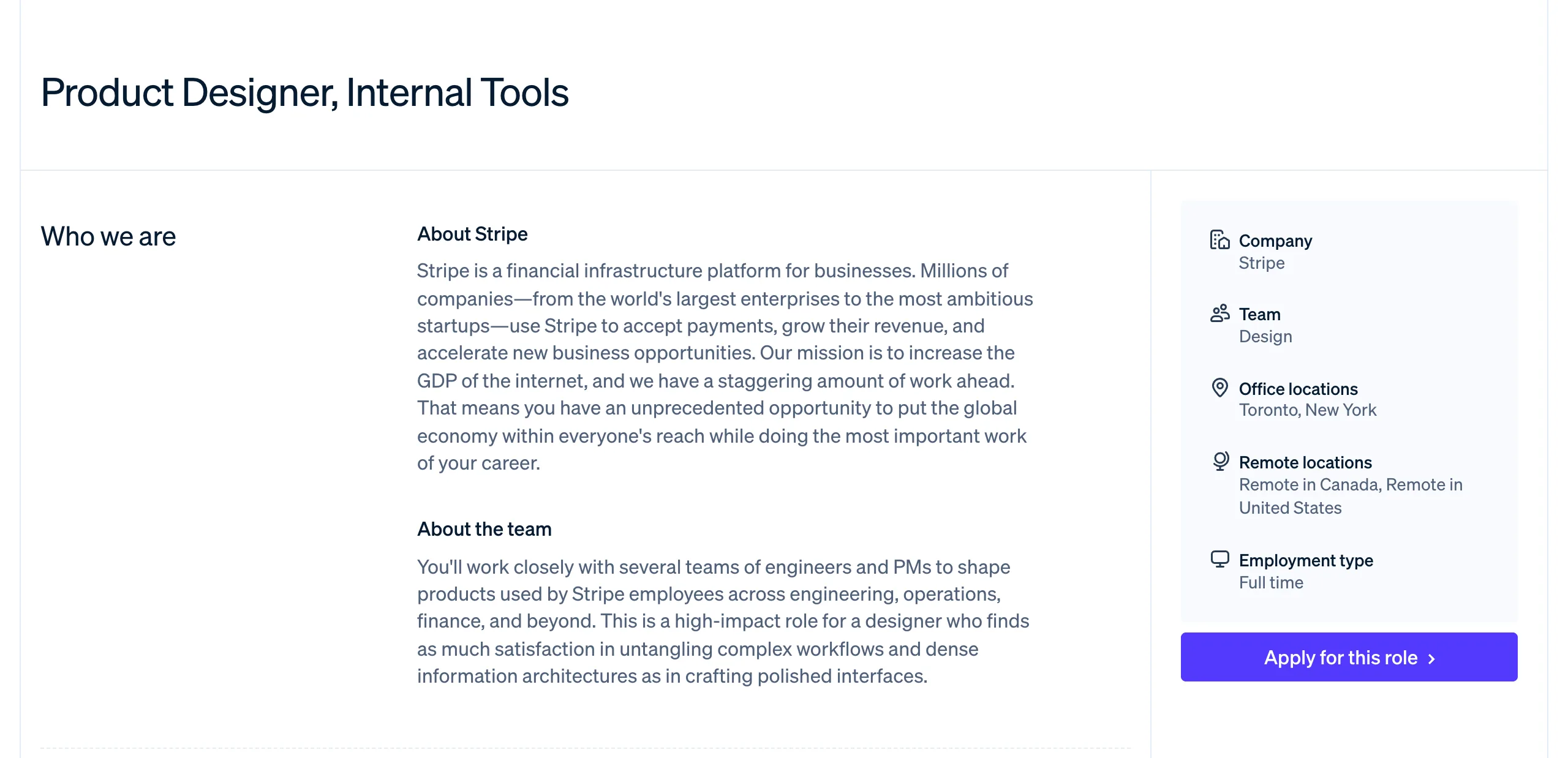
Once a business knows what it wants to improve, there are still important decisions to make about how a tool should support the people using it. I think this is where product designers can make a valuable contribution, and Stripe offers a useful example of a company investing in that work. I recently came across their Product Designer, Internal Tools job posting, which specifically asks for someone who enjoys untangling complex workflows as much as designing a polished interface. With an annual US base salary range of $159,300 to $238,900, the role shows how seriously the company is investing in improving their experience.
I find that encouraging. As AI helps teams build software faster, tools that were once too expensive to justify can become viable, creating opportunities to reduce repetitive work, make information easier to find and help companies limit human error. That opportunity extends to smaller businesses, too. If you can help a family-owned shop by building a tool with a good interface, reliable data systems and a backend that supports its work, you can be worth every penny.
For anyone considering a UX design career path, I think this is a promising direction. AI can help build the tools, but it can’t empathize with the people using them. We can, and that empathy shapes the judgment we bring to solving their everyday problems in a way AI alone simply cannot do.
How to Start Designing Internal Tools#
Internal tools design draws on the same foundations as other areas of product design. If you’re learning how to become a product designer, focus on understanding your users, organizing information clearly and measuring whether your solutions actually help.
Start your UX research with a workflow people have frustrations about. Watch how they use it, ask about their workarounds and find out where information gets lost. Learn enough about software architecture to understand how the interface, data and backend fit together as that understanding is essential to designing something that works beyond the idea stage.
For a product design portfolio, I recommend finding a small business with a problem you can help solve. Build a working tool and document your decisions, feedback and changes along the way. One real tool with a good interface which is proven to work in practice says a lot more about your ability than a portfolio full of concepts.
The practical skills I would focus on are:
- Motion design. Use movement purposefully. Micro animations in UI can help people understand more about the interface they’re using.
- User interface and micro interactions. Make screens easy to use, confirm when actions succeed and guide people when something goes wrong.
- HTML and CSS. Learn enough to prototype interfaces in a browser and see how they behave with different content and screen sizes.
- Branding and visual taste. Bring a considered approach to typography, color and consistency. Internal software deserves the same care as anything a customer sees.
- Data. Understanding how data is managed, manipulated, and served to the user in the form of an interface and backend.
- Measure. Improve your ability to correctly test and measure the results of your tools. This will help add a backbone to the work you bring to a business.
- Prototyping. Learn how to leverage AI to build well organized brand libraries in the form of stylesheets, component libraries, etc. And play around with scaling those to large interfaces.
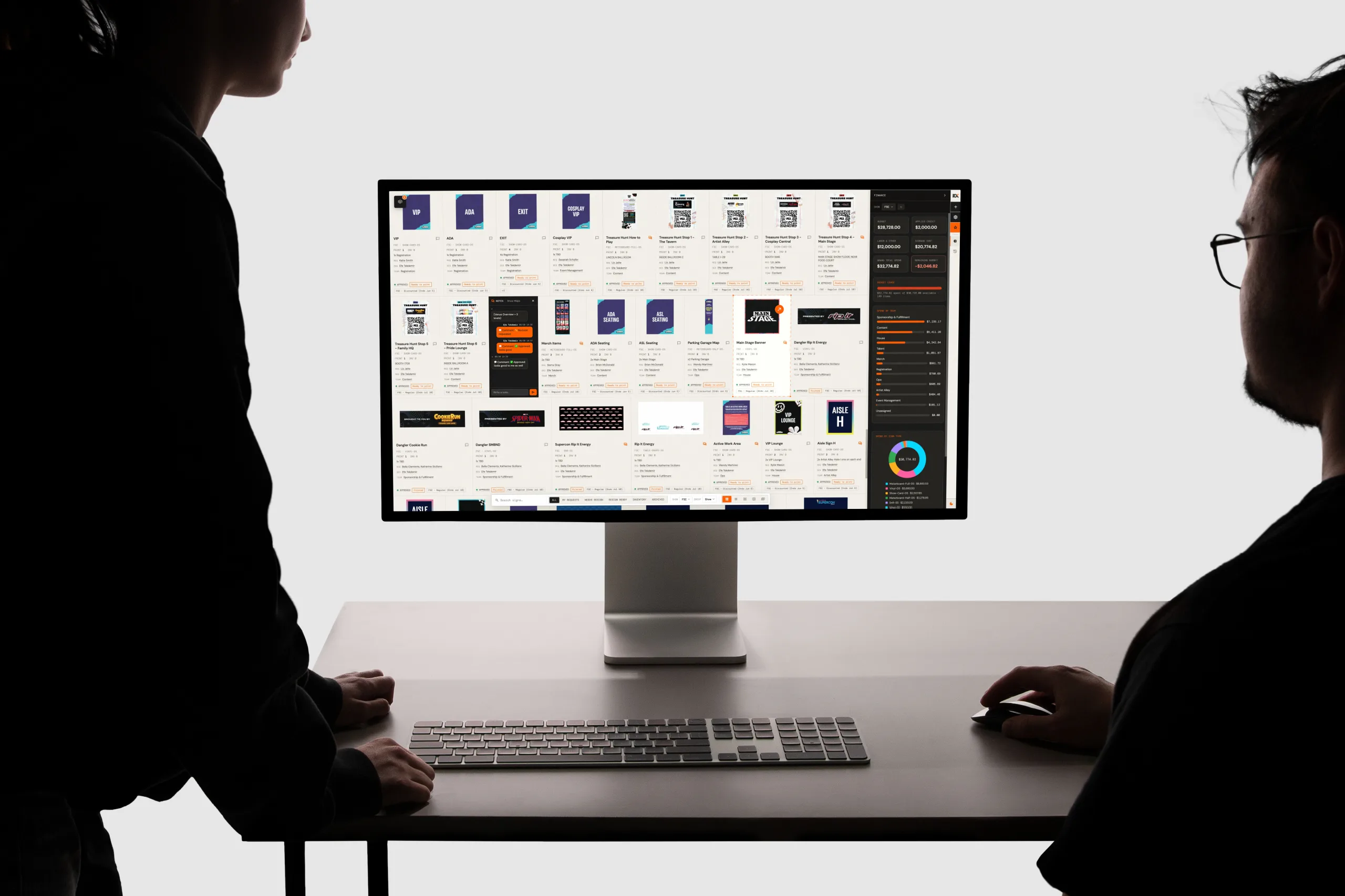
My own experience with internal tools design began while managing signage for a portfolio of comic conventions. The workflow was held together by disjointed spreadsheets, so I knew firsthand how frustrating it was to keep the work organized. That experience led me to build Signage Workspace, the data layer and tool that replaced the old workflow, so the team could work from one shared record.
Bring the messiest spreadsheet you have.
If your business has a workflow that costs your team time or forces people to repeat the same work, that is exactly the kind of problem I can help you solve.